Marcelina
Martin was born in Atlanta in 1950. She grew up riding horses on her
Grandparent's tobacco farm. Living close to the land nurtured a strong
sense of wonder and an eye for the magic of Light. Her grandmother was
a poet, healer and musician. Marcelina's love of photography began at
Baldwin High School in Milledgeville. She could be found down by the
river on her horse Lucky or parked in the town cemetery reading poetry
where Flannery O'Connor rest nearby. Originally a French major in
college, Marcelina quickly realized art was her true love. She changed
her major
to photography. Several US photographers interested her but her final
choice was John McWilliams, a protege of Harry Callahan, who taught at Georgia
State University. She
graduated
with a Bachelor of Fine Arts in 1974.
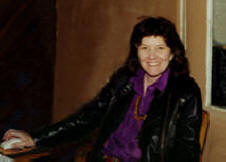 "My roots were put down deep in the richness
of the Georgia Coastal Plains. My parents told me I could be anything I
wanted, and I believed them. Their strength of character and intense
individualism required me to find my truest self."
"My roots were put down deep in the richness
of the Georgia Coastal Plains. My parents told me I could be anything I
wanted, and I believed them. Their strength of character and intense
individualism required me to find my truest self."
During her years in Atlanta she was involved with
the Women's Movement and Civil Rights, documenting events of each from
1969-1975. In 1972 she traveled with John Lewis and Julian Bond in
Mississippi as a videographer for a documentary on Black Voter
Registration. Drawn deeper and deeper into Buddhist studies she
moved to Boulder, Colorado to attend Naropa Institute in
1975. Her studies of Buddhist psychology and with performing
artists like Meredith Monk and Anne Waldman later influenced her ideas
of art as spiritual practice. From
1979 until 1992, she lived in the San Francisco Bay Area where
Marcelina immersed herself in the Women's Spirituality Movement. She
sat for twelve years with the San Francisco Zen Center, Green Gulch Zen
Center, and Hartford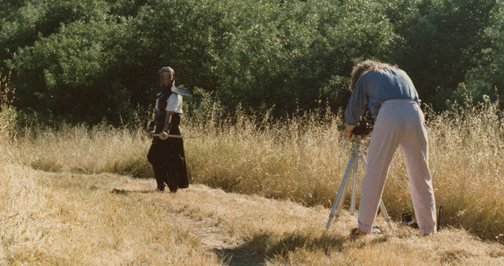 Street Zen Center. In 1981, she began leading women's spirituality
groups and Dream Theater with Hallie Iglehart Austen, author of
WomanSpirit: A Guide to
Women's Wisdom and Heart of the Goddess. During this time
Marcelina crafted a process she named Photomythology from a
synthesis of her understandings of mythology in Neolithic cultures, of
Dreamwork of the Senoi Tribe in Malaysia and of the principles of
Holistic Healing. Her photographic sessions combined spiritual wisdom
with the power of visual imagery.
Street Zen Center. In 1981, she began leading women's spirituality
groups and Dream Theater with Hallie Iglehart Austen, author of
WomanSpirit: A Guide to
Women's Wisdom and Heart of the Goddess. During this time
Marcelina crafted a process she named Photomythology from a
synthesis of her understandings of mythology in Neolithic cultures, of
Dreamwork of the Senoi Tribe in Malaysia and of the principles of
Holistic Healing. Her photographic sessions combined spiritual wisdom
with the power of visual imagery. In 1981 Marcelina met Elsa Gidlow.
Contact with Elsa was an ongoing conversation about love, philosophy,
art and community. This friendship changed the course of Marcelina's
life for it changed her dreams. Elsa had shared generously her wisdom
from eight decades of an amazing life. The connecting thread was a
fierce passion for the artist's life. When Elsa died in 1986, Marcelina
served as co-executor of Elsa's estate and created Druid Heights
Artists Retreat. During the years as Executive Director of the artists'
retreat, Marcelina's passion for artists' community grew deeper and
eventually led to her creating Wild Hearts Ranch retreat in Taos, New
Mexico.
In 1981 Marcelina met Elsa Gidlow.
Contact with Elsa was an ongoing conversation about love, philosophy,
art and community. This friendship changed the course of Marcelina's
life for it changed her dreams. Elsa had shared generously her wisdom
from eight decades of an amazing life. The connecting thread was a
fierce passion for the artist's life. When Elsa died in 1986, Marcelina
served as co-executor of Elsa's estate and created Druid Heights
Artists Retreat. During the years as Executive Director of the artists'
retreat, Marcelina's passion for artists' community grew deeper and
eventually led to her creating Wild Hearts Ranch retreat in Taos, New
Mexico.
Marcelina speaks of her
art this way:
My photography developed along several paths: recording activist
history, exploring visually the profound connections between the inner
and outer landscapes, and using art as a tool of spiritual
practice for psychic and psychological transformation. Photomythology
evolved from the observation that America is primarily a visually
oriented culture. The way we perceive reality is influenced by a
complex range of imagery. Heroes and myths are intricately woven into
our psyches. Our ideas of individual identity, social place, and
interrelatedness coalesce from this matrix of images. Some of the most
adverse effects of this visual information are submerged in the
unconscious, leaving many of us adrift, unaware that we are in its
undertow. Women are particularly vulnerable to manipulation through
imagery due to the degree of sexism in our culture. Over thousands of
years, our experiences of authentic womanhood have been erased from the
public domain and replaced by fabrications designed for exploitation.
Even if we consciously reject negative images, their power can
influence us subconsciously unless we change them at a deep level. If
not brought to light and examined, our images evolve into private and
eventually public myths and standards. Images we hold are the
foundation for the content and action of our lives. Through inquiry
into our inner imagery, we can expose outdated myths, produce
life-affirming images, and cultivate a dynamic vision of wholeness. In
consciously creating our imagery and mythologies, we affect our
political, economic, and social attitudes which inspire change first in
our inner world then eventually our outer world. From this
philosophical base, I created images from the myths of our lives with
an intention of integrating the fragments into a whole, dynamic vision
of ourselves.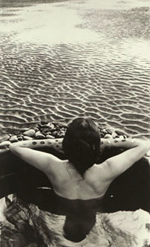
The roots of art are in shamanism. The shaman was a healer in
her/his community that worked with the individual and collective psyche
through art. Many artists work directly with this knowledge of the
power of imagery. This is the focus and drive behind their art. I am
one of these artists. When we create art, we enter into the realm of
the Divine. In this place we can bring our deepest fears, conflicts,
hopes and joys and emerge purged, healed and connected. My dear friend
poet Elsa Gidlow believed that we
were all artists. Definitely there are cultures like Bali where most
people express themselves through art. I also believe that we are all
artists. I believe we can all live life through our creativity. The
artist is called to art with a compelling force that
draws her creativity into existence. There is no choice but to
create. I believe passionately in art as a healing force and that art
arises from well-being or from the innate force within all life to move
towards wholeness.
Ms. Martin's photography has been published in numerous periodicals
such as The Great Speckled Bird, Frontiers, Heresies, Southern
Exposure, Woman of Power, Sage Woman, The Advocate, On Our Backs,
Motive Magazine, 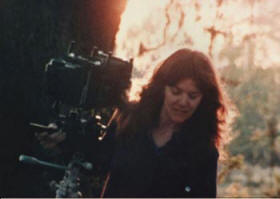 Calyx
and such books as: The Southern Ethic, Women See
Woman, Our Right To Love, Womanspirit: A Guide to Women's Wisdom, Women
& Aging, Elsa: I Come With My Songs, Blue Calendar, The Womanspirit
Sourcebook, The Once and Future Goddess, The Heart of the Goddess,
Rebels, Rubyfruit and Rhinestones, The Box: Remembering the Gift and
Women Artists of the American West. Her prints have been exhibited in
Australia, Germany, Denmark, and throughout the United States. Ms.
Martin's work is included in the Women's History Archives Collection at
Harvard University and Brown University. Her images are being used in
online courses at Columbia University, University of New Mexico, and
Purdue University. Her book, Lesbian Sacred Sexuality, is used at
California Institute of Integral Studies in the Women's Spirituality
Program. Since 1976, she has divided her time in the California Bay
Area, Santa Fe, Taos and Boston. In 2002, she returned to
Milledgeville, Georgia to be closer to her family. In Georgia she
taught digital photography at Andrew College and promoted the
Performing Arts of India in America with
Ganesh
Academy of Indian Arts. Her book, "A Guide to Flannery
O'Connor's Georgia" by Dr. Sarah Gordon and Craig Amason published by The
University of Georgia Press came out in April 2008.
Since Ms. Martin's travels in India in 2007, she has been
producing both promotional and documentary films. Her documentary
website is at Two
Spirit Films.
Promotional films on this site include The Living Dharma, Raw Detox,
Archetypal Patterning, Preserving Gohn Dagow, Pure Water for
India. Her film, Mining The Unconscious, is a documentary of artists who
integrate
spirituality and art. The World Premiere was in Dharamshala, India. Mining was also screened in eight other festivals including the Santa Fe Film Festival and the Foundation of Universal Responsibility His Holiness the Dali Lama. Short films include Odissi Indian
Classical Dance, and Healing Through Raw Food. My Mother's Daughter is still in production. It is the
journey of a group of African-American women discovering and
reconciling their African roots. We are blessed to have Desmond Tutu's
daughter Naomi Tutu in our cast. Ms.Martin has also worked as a cinematographer in
short and feature films in Santa Fe. After researching the life of Irish Revolutionary, Ella Young and
her connection with Elsa Gidlow and Druid Heights Community above Muir Woods in Marin County, California, Marcelina is producing and directing a feature-length film called Elsa: I Come With My Songs.
Calyx
and such books as: The Southern Ethic, Women See
Woman, Our Right To Love, Womanspirit: A Guide to Women's Wisdom, Women
& Aging, Elsa: I Come With My Songs, Blue Calendar, The Womanspirit
Sourcebook, The Once and Future Goddess, The Heart of the Goddess,
Rebels, Rubyfruit and Rhinestones, The Box: Remembering the Gift and
Women Artists of the American West. Her prints have been exhibited in
Australia, Germany, Denmark, and throughout the United States. Ms.
Martin's work is included in the Women's History Archives Collection at
Harvard University and Brown University. Her images are being used in
online courses at Columbia University, University of New Mexico, and
Purdue University. Her book, Lesbian Sacred Sexuality, is used at
California Institute of Integral Studies in the Women's Spirituality
Program. Since 1976, she has divided her time in the California Bay
Area, Santa Fe, Taos and Boston. In 2002, she returned to
Milledgeville, Georgia to be closer to her family. In Georgia she
taught digital photography at Andrew College and promoted the
Performing Arts of India in America with
Ganesh
Academy of Indian Arts. Her book, "A Guide to Flannery
O'Connor's Georgia" by Dr. Sarah Gordon and Craig Amason published by The
University of Georgia Press came out in April 2008.
Since Ms. Martin's travels in India in 2007, she has been
producing both promotional and documentary films. Her documentary
website is at Two
Spirit Films.
Promotional films on this site include The Living Dharma, Raw Detox,
Archetypal Patterning, Preserving Gohn Dagow, Pure Water for
India. Her film, Mining The Unconscious, is a documentary of artists who
integrate
spirituality and art. The World Premiere was in Dharamshala, India. Mining was also screened in eight other festivals including the Santa Fe Film Festival and the Foundation of Universal Responsibility His Holiness the Dali Lama. Short films include Odissi Indian
Classical Dance, and Healing Through Raw Food. My Mother's Daughter is still in production. It is the
journey of a group of African-American women discovering and
reconciling their African roots. We are blessed to have Desmond Tutu's
daughter Naomi Tutu in our cast. Ms.Martin has also worked as a cinematographer in
short and feature films in Santa Fe. After researching the life of Irish Revolutionary, Ella Young and
her connection with Elsa Gidlow and Druid Heights Community above Muir Woods in Marin County, California, Marcelina is producing and directing a feature-length film called Elsa: I Come With My Songs.
Copyright 2021